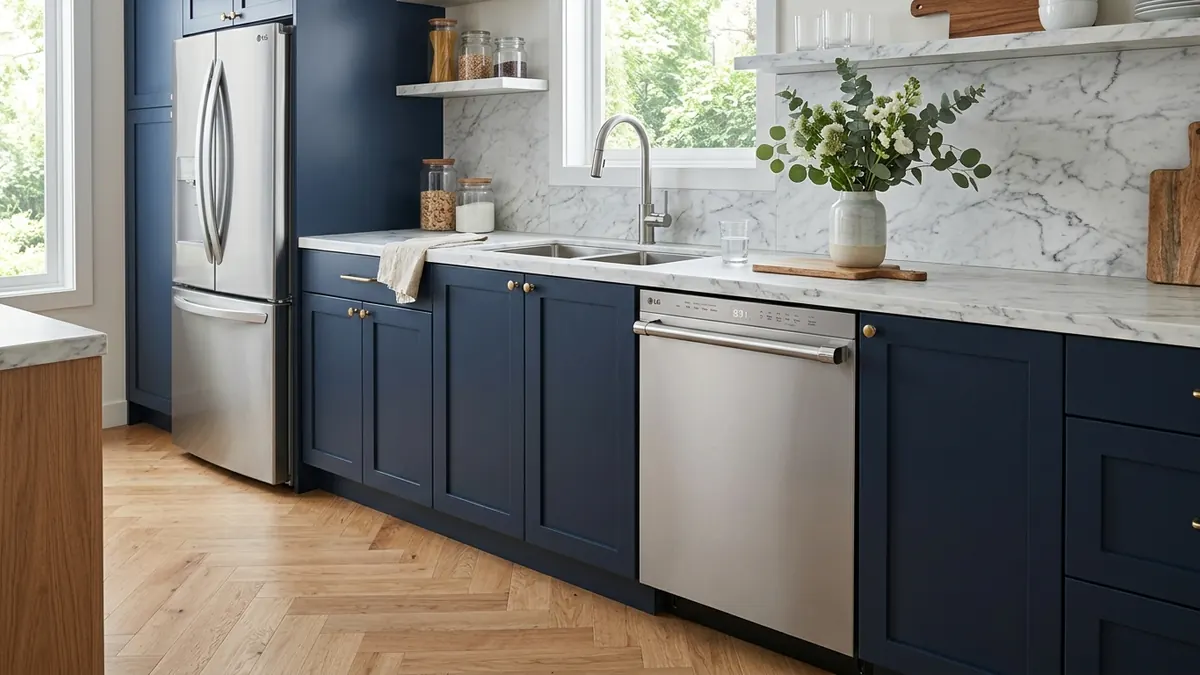
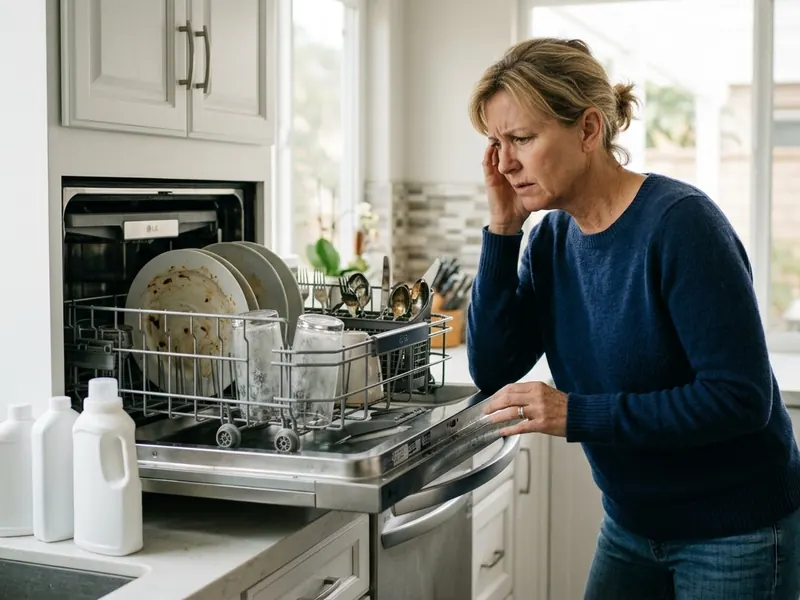
Dishes come out with food stuck on, a gritty or white film, or glasses that look cloudy. Sometimes the machine barely fills, or the display won't light at all.
Detergent works poorly in cold water. The supply should be on the hot line and arrive around 120°F, not above 140°F. A long pipe run from the water heater or a dishwasher plumbed to the cold line is a common reason for dirty dishes.
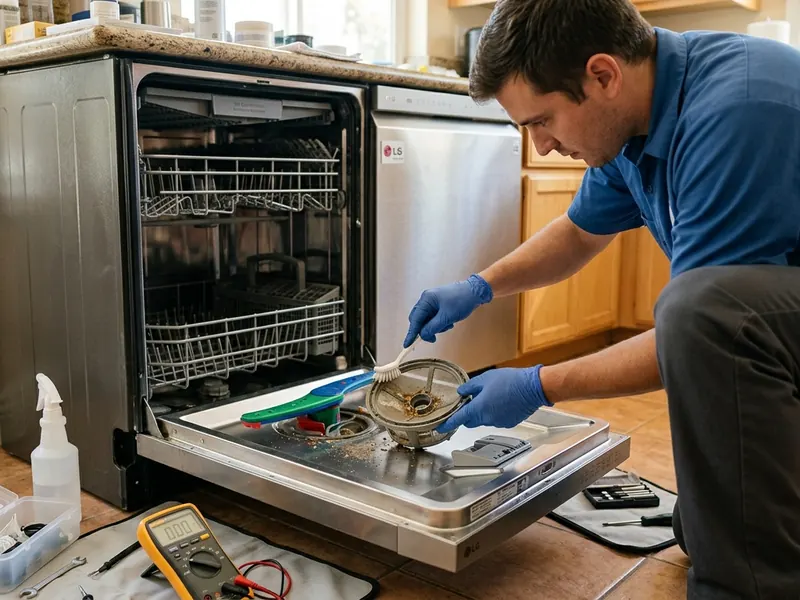
Food and hard-water scale close up the filter and the spray arm holes. Water still circulates, just weakly and not where it needs to go.
A partly closed valve, a kinked hose, or a calcium-clogged screen at the inlet valve starves the machine. Water pressure below about 20 psi or above 120 psi is a plumbing problem the dishwasher can't work around.
The board counts water with a small flow meter. If the meter's wheel sticks or its signal drops out, the fill is wrong. A failed inlet valve gives you little or no water and an IE code.
If the heater or its thermistor fails, the wash water never gets hot and the drying is poor too. These usually show up as HE or tE.
A worn circulation pump moves less water through the arms. It's often noisy as well, and can throw an LE code.
| Code | Meaning |
|---|---|
IE | Water inlet error: not enough water came in |
HE | Heater error: wash water isn't heating |
tE | Thermistor error: temperature sensor fault |
LE | Motor error: circulation motor locked or not turning properly |
We start with questions: which cycle, which detergent, whether rinse aid is used, any codes lately. A lot of not-cleaning calls come down to loading and water temperature, and it's better to find that out in two minutes than replace a part that wasn't bad.
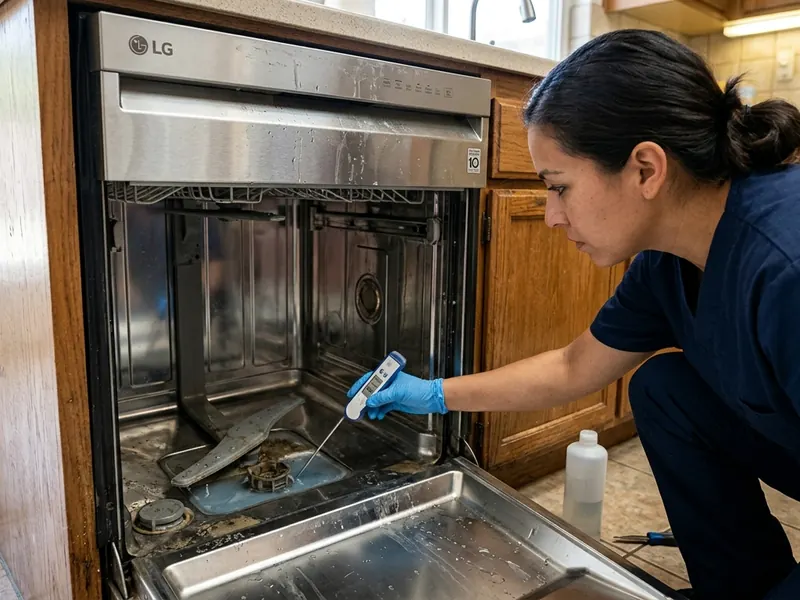
We put the machine in test mode, run only the fill step until water covers the bottom of the tub, and measure it with a temperature probe on the meter. Around 120°F is right. Lukewarm water tells us the problem is the plumbing or the heater, not the pump.
With the supply off we take the hose off the inlet valve and look at the screen for scale. Then we measure the valve. Depending on the model it's either a 120V AC valve reading roughly 900 to 1,300 ohms, or a low-voltage DC valve around 8 to 12V and 20 to 30 ohms. If the valve gets voltage and doesn't open, the valve is bad. If the board never sends voltage, it's the board or the harness.
If water comes in but the count is wrong, we check that the flow meter's wheel turns freely, that the board is sending it 5V DC, and that it pulses back a signal while water flows. No pulse with power present means a bad flow meter.
We confirm 120V at the outlet or junction box, then through the noise filter board into the main board, and check the main board's status LED. If the main board is alive, we measure the low-voltage feed to the display board (about 12V DC on older models, 16.5V DC on newer ones). Voltage there with a dark display means the display board. No voltage means the main board or the harness between them.
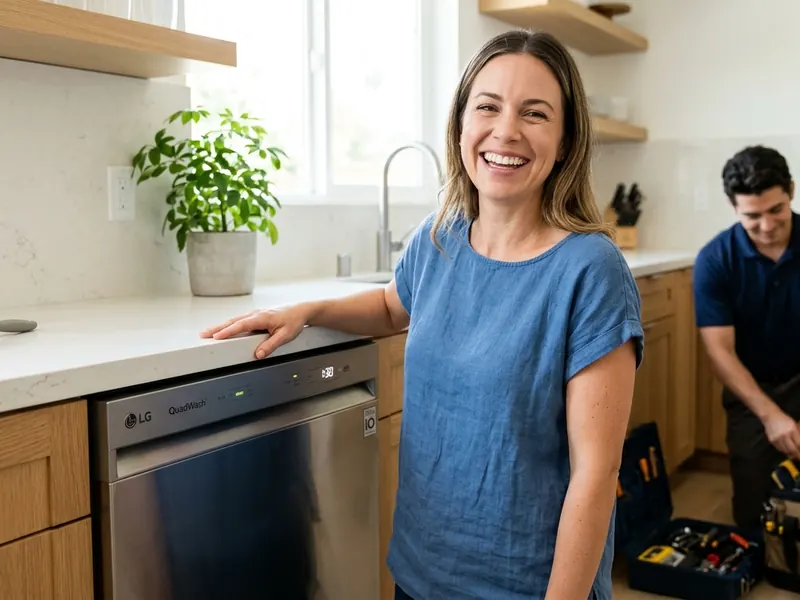
We see a lot of LG dishwashers that are mechanically fine and just need a clean filter, clear spray arms and hot water at the first fill. We check those first and tell you straight. When it is a part, it's usually the inlet valve, the heater circuit or the circulation pump, and we confirm it with readings before ordering anything.
Most often it's a clogged filter, blocked spray arm holes, or cold water at the start of the cycle. If those check out, we look at the fill, the heater and the circulation pump.
Hard water and no rinse aid are the usual cause in Orange County. Keep the rinse aid filled and clean the filter and arms regularly. A film that keeps getting worse can also mean the water isn't heating.
Make sure the valve under the sink is fully open and the hose behind the unit isn't kinked. If both are fine, the inlet screen may be clogged with scale or the inlet valve or flow meter has failed, which is a technician job.
Factory authorized LG repair, parts on the van, 90-day warranty. Same-day across Orange County.