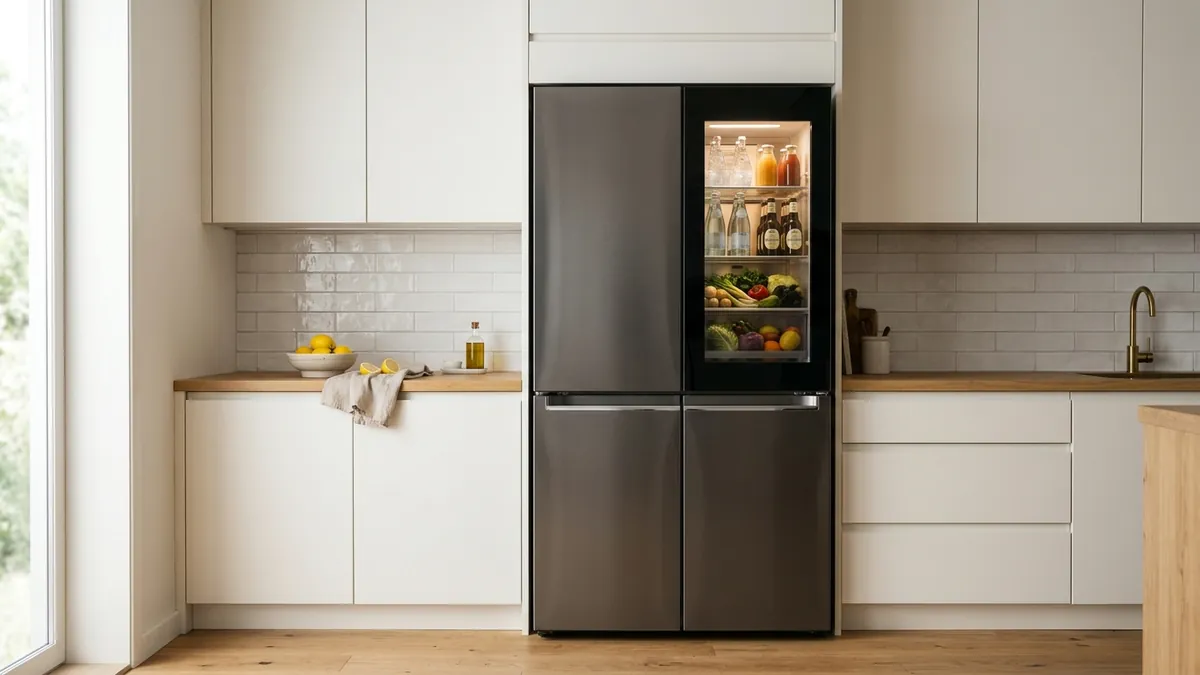
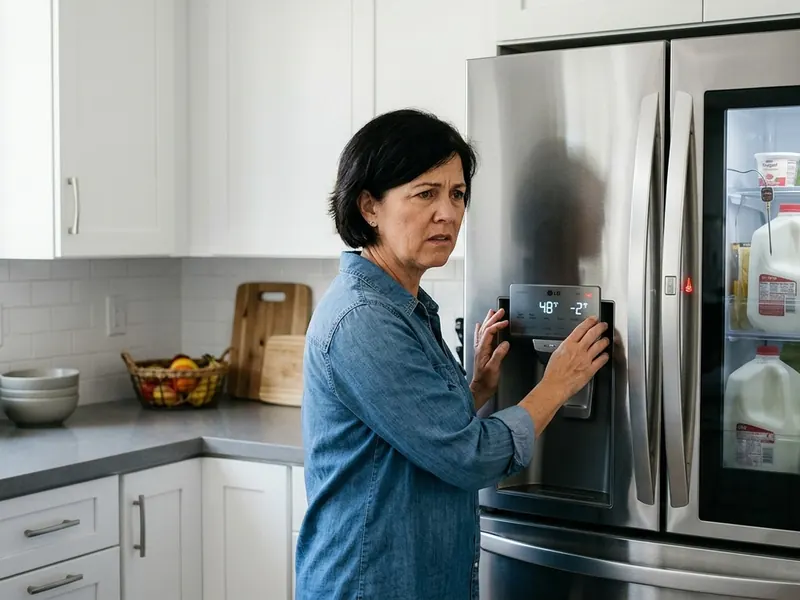
The freezer still feels cold, but the fridge side keeps creeping up into the 40s, milk spoils early, and there's a layer of frost on the freezer's back panel that never goes away.
The heater under the evaporator coil burns out with age. With no heat during defrost, frost builds up on the coil until air can't pass through it. The freezer stays cold longest because it sits right next to the coil, while the fridge side, which gets its air from the same coil, warms up first.
The sensor clipped to the evaporator tells the board when the coil is warm enough to end defrost. A sensor that reads wrong ends defrost too early or never starts it. A melting fuse in the same circuit opens permanently if it overheats, which looks exactly like a dead heater.
The heater and sensor can both be fine while the board simply never sends power to the heater. This is less common than a failed heater, and we only call it after the parts test good.
Warm, humid air loads the coil with frost faster than a normal defrost can clear it. The frost pattern points to the source: frost on the left side of the coil often means leaking ice room gaskets, frost around the door and rails means a door seal problem.
Some LG models have a small flap on the evaporator drain tube. If it sticks open, warm air from below creeps up into the coil area and frost forms in the middle of the coil.
The fridge section gets cold air through a duct from the freezer and returns it through another. Ice in the return duct, a stuck damper or a slow fan starves the fresh food side even when defrost works.

| Code | Meaning |
|---|---|
Er dH | Defrost did not complete in time, usually a defrost heater, fuse or sensor fault |
Er FF | Freezer fan error, often the fan blade frozen in ice from a defrost failure |
Er rS / Er FS | Fridge or freezer temperature sensor fault |
We record both compartment temperatures with a probe thermometer. If the freezer is also warm, it's a different problem, a no-cool or sealed system issue, and we diagnose it as such. If the freezer is cold and the fridge is warm, we look at frost on the back panel and run the fans and damper in test mode. Cold air should blow from the freezer up into the fresh food section. If it doesn't, we check whether the return duct is blocked with ice.
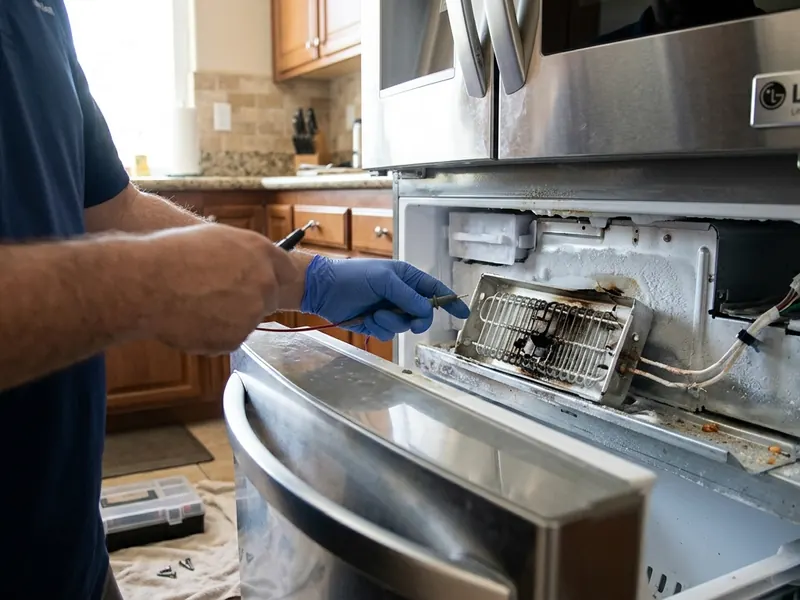
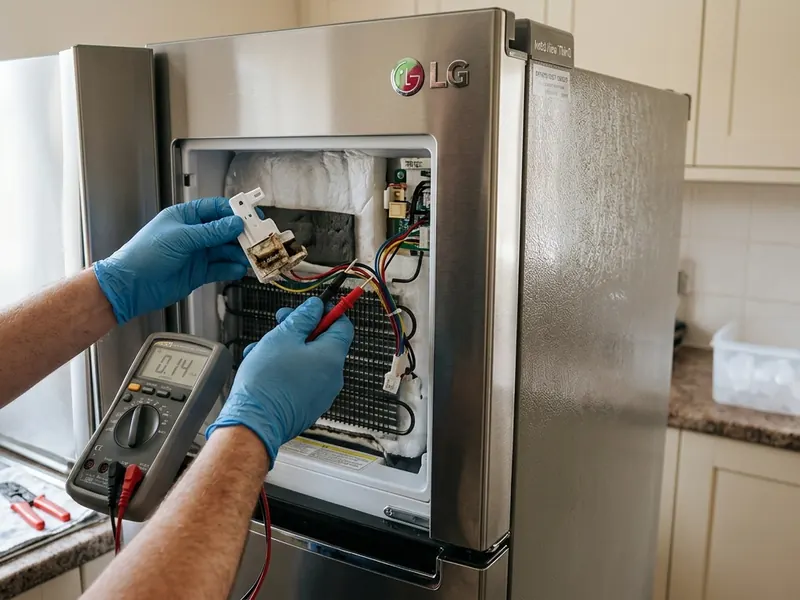
With the fridge unplugged, we disconnect the defrost connector at the main board and measure the heater and the sensor through the harness, probing from the wire side so the connector isn't damaged. A good heater shows a steady resistance in the range listed for that model. Open means no current can flow. The sensor is compared against its temperature chart.
An open reading from the board doesn't prove the heater is bad. We go behind the freezer panel and measure the heater, the melting fuse and the sensor directly. That tells us exactly which part failed, instead of replacing all three.
If the parts measure good, we force a defrost from the test mode and check for 120V AC at the board's heater output. The forced defrost won't start if the evaporator is already above about 46°F, so we test before the coil warms up. No output with a good heater and sensor means the main board.
Once the coil is clear, we look at where the frost formed. Heavy on the left points at the ice room gaskets, middle of the coil at the drain tube flap, around the door and rails at the door seal. Fixing that leak keeps a new heater from being overwhelmed.
When the freezer is cold and the fridge is warm, we check the defrost system before anyone starts talking about the compressor. A heater, sensor or fuse is a much smaller repair than sealed system work, and we prove which part failed with a meter before replacing it. Our repair carries a 90 day parts and labor warranty.
Both sections are cooled by the same coil behind the freezer panel. When defrost fails, frost blocks that coil and the fan can't push air up into the fridge, so the fresh food side warms first. A failed defrost heater, sensor or fuse is the usual cause.
Ice on the freezer floor or in the drawers usually comes from a clogged drain or a leaking seal. Here the problem is the heater, sensor or control that's supposed to melt the frost off the coil. The fix is in the defrost circuit itself.
As a stopgap, yes. Unplugging it for a day or two with the doors open clears the coil, but if the defrost circuit has failed the frost comes back within one to two weeks. Use that time to schedule the repair.
Factory authorized LG repair, parts on the van, 90-day warranty. Same-day across Orange County.