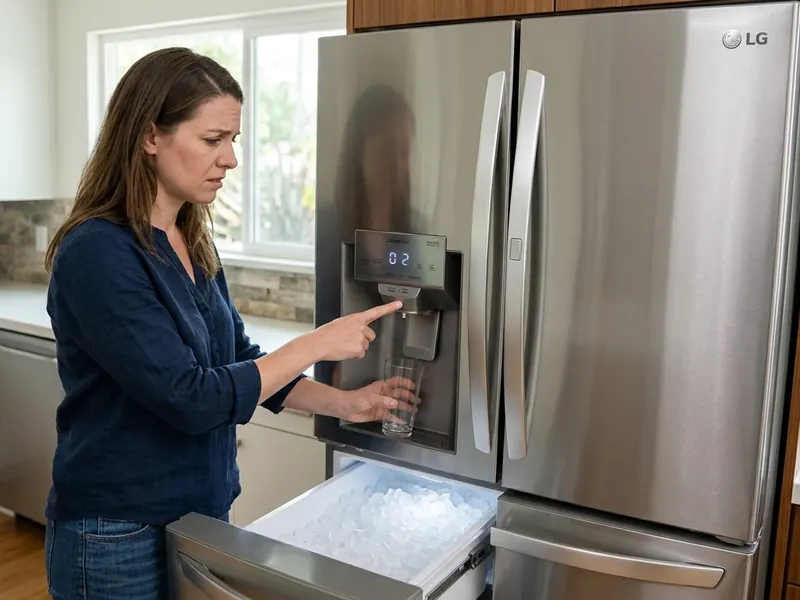
The ice bin is full but nothing comes out when you push the paddle, the dispenser hums and stops, or you pick cubed and get crushed ice anyway.
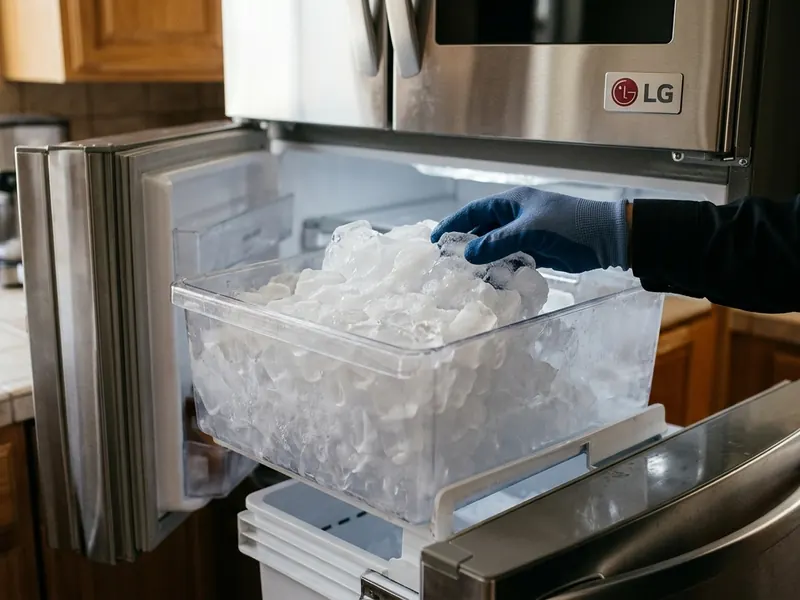
The most common cause by far. Cubes melt slightly and refreeze into a block the auger can't move. Where the clump sits tells us why: on top usually means the ice maker is overfilling or its fill tube drips, on the bottom points at the dispenser flap not sealing, and all over suggests a door left open or very light ice use across many defrost cycles.
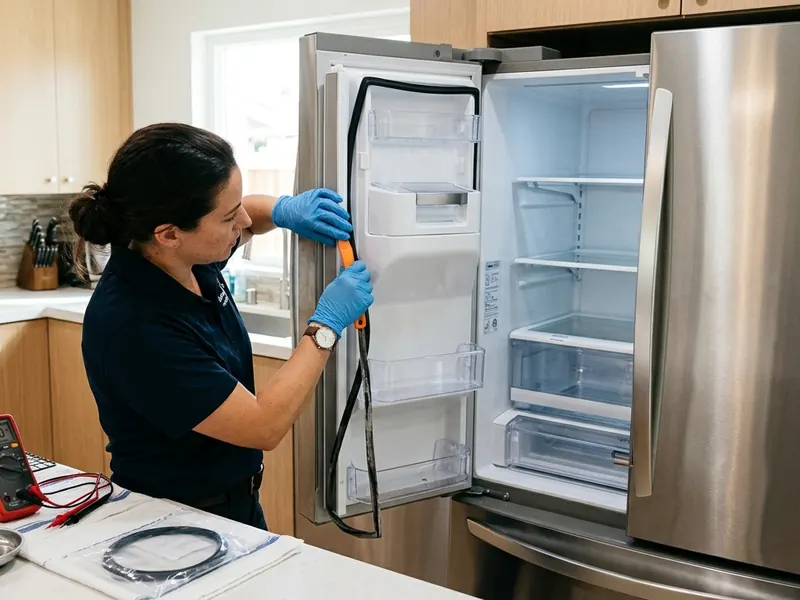
In-door ice systems are kept cold by freezer air ducted through small gaskets into the ice room. When those gaskets or the ice room door seal tear or flatten, warm air leaks in and the ice clumps over and over.
The motor behind the bucket turns the auger that pushes ice out. Older units use a 120V AC motor, many newer ones use a 24V DC three-phase motor driven by a sub board. If the motor gets power and doesn't turn, it's done.
When you press the paddle, a small motor or, on older models, a solenoid opens the flap in the ice chute. A stuck flap means the auger runs but ice piles up behind a closed door. A flap that doesn't close fully lets warm air up into the bucket.
The control tells the auger which way to spin: one direction crushes, the other passes cubes through. Older models used a solenoid that rests in the crushed position by default, so a dead solenoid means crushed ice only. On newer models a missing direction signal from the display board does the same.
The dispenser won't run if the board thinks a door is open. If water works but ice doesn't on a model with a separate ice switch, the switch or the board that reads it is the next suspect.
| Code | Meaning |
|---|---|
Er IF | Ice fan error. With this code showing, both ice and water dispensing are suspended until the fan problem is fixed |
We check for any error code and Control Lock first, since either one disables the dispenser. Then we press the paddle and listen. A hum with ice in the bucket sends us to the bucket and auger. No sound at all sends us to the door switches and the paddle circuit.
Push-type switches should turn the interior lights off when pressed. Magnetic reed switches sit in the top hinge covers and should close with a magnet held over them. If the board still sees a door as open, we reseat the hinge connectors one at a time, a common fault on fridges whose doors were removed for delivery.
Pressing for ice should open the chute flap and then start the auger. We confirm the flap motor or solenoid moves, then measure the auger. A 120V AC auger is checked for voltage and winding resistance, typically in the 30 to 40 ohm range on the models we see. On 24V DC three-phase augers, the board needs an enable signal and a speed signal from the display, each around 5V DC when you press the paddle, before it drives the motor.
On DC-auger models a direction line reads about 5V DC for crushed and 0V for cubed. If it never changes, the display board isn't sending the selection. On solenoid models we check that the solenoid pulls in when cubed is selected. Mini cube in-door ice makers have their own small auger, around 2.6 ohms across its windings, which we test right at the connector.
If the bucket was frozen solid, clearing it is only half the job. We inspect the chute flap seal with a light, check the ice room gaskets and door seal, and watch the ice maker fill to make sure it isn't overfilling. Otherwise the block comes back in a week.
We see more frozen ice buckets than broken auger motors, and chipping the block out without fixing the warm air leak just buys a few days. We find out why the ice clumped, then test the motor, flap and selector so the fix holds. If your fridge has Craft Ice, keep in mind those spheres come from a separate tray in the freezer and drop into a bin, they don't go through the door chute.
Usually the ice in the bucket has fused into a block, the bucket isn't seated on the auger, or the chute flap is stuck closed. Less often the auger motor itself has failed. If water also stopped, look for an error code or a door switch problem.
LG ice systems default to crushed when the selector isn't working. On older models a solenoid that has failed leaves the system in crushed. On newer ones the display board stops sending the cubed signal to the auger control.
Yes. Craft Ice makes about three spheres every 18 to 30 hours in the default mode, or six in the 6 ICE mode, and a new install can take up to 48 hours to start. That's normal production, not a fault.
Factory authorized LG repair, parts on the van, 90-day warranty. Same-day across Orange County.