You've been told your LG refrigerator has a sealed system problem: a refrigerant leak, a restriction, or a compressor that runs but doesn't pump. Now you want to know whether the repair is worth it and how to tell it's being done right.
The most common sealed system failure we find. The leak is on the suction side, so instead of just losing refrigerant the system pulls in air and moisture. Moisture mixes with compressor oil into sludge, which later clogs the capillary tube and wears out the compressor. On gauges the low side runs below normal while the high side climbs above normal.
Both pressures run low, amps are normal to low, and frost covers only part of the evaporator. Typical spots are the bottom of the condenser where it sits in the drain pan (steel condensers can rust through there), the factory fitting between the condenser and the hot loop around the door openings, and the hot loop itself, which often shows rust along the cabinet seams.
Something blocks flow: sludge, debris, or too much sealant at a joint. A restriction before the drier pumps the refrigerant into the condenser and leaves the low side in deep vacuum, sometimes with the high side near 0 psi. Pressures take far longer than 10 minutes to equalize when the fridge is unplugged.
A blockage at the discharge line or in the first half of the condenser has nowhere to send the refrigerant. The compressor strains, amps climb, and it shuts off soon after starting. The repair includes a new compressor and drier as well, because the strain damages it.
The compressor runs but doesn't pump. Low side reads above normal, high side below normal, current is low and there's little or no frost. In the worst case the pressures barely move at all. It's often the result of an earlier low side leak, which is why we pressure test before just swapping the compressor.
We don't see undercharged LG units from the factory. When the charge is wrong, someone worked on it before and didn't weigh it in. Too little: low pressures, partial frost. Too much: high pressures, a loud compressor, and frost or sweating all the way back along the suction line to the compressor.
| Code | Meaning |
|---|---|
9 blinks (main board LED) | Power trip: board output under 60V means the board, 60V or more points to the sealed system |
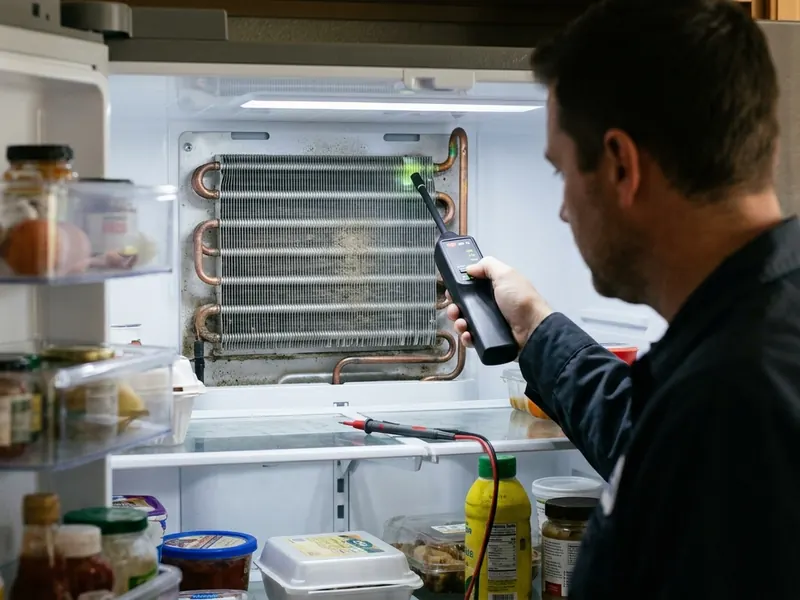
A lot of no-cool calls labeled 'sealed system' are airflow, defrost, a fan, a temperature sensor or a hidden error code. Before we tap the system we record the freezer and fridge temperatures (target 0°F and 37°F), compressor amps and voltage, and look at the frost pattern on the evaporator. With the board's compressor test we expect the compressor to start and reach over 80V AC within about a minute. Only then do we install gauges.
After at least 25 minutes of running we read both sides. Normal on R134a is roughly 5 inHg vacuum to 5 psi on the low side and 85 to 110 psi on the high side. On R600a it's 10 to 15 inHg vacuum on the low side and 45 to 60 psi on the high side. Which side is off, and in which direction, separates a leak from a restriction from a weak compressor. Room temperature shifts these numbers, so we read them together with amps and frost, not alone.
We unplug the fridge and time how long the two gauges take to meet. Under 5 to 10 minutes is normal. Much longer means a restriction. If they meet quickly but at a low pressure (below about 40 psi on R134a or 15 psi on R600a with a warm cabinet in a 70°F room), refrigerant has leaked out. On dual evaporator models a restriction to one evaporator only still equalizes, and shows up as one section cooling and the other not.
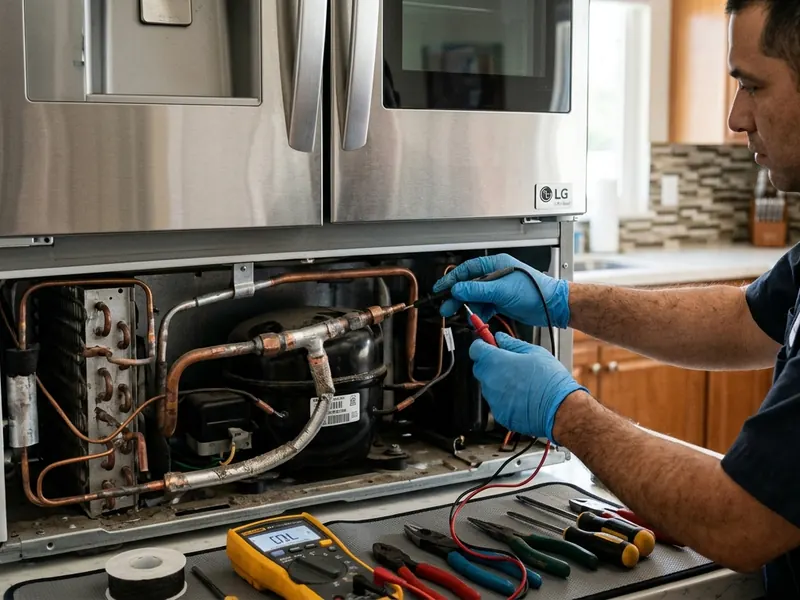
We recover the refrigerant, cut out the drier and open it, and check the compressor oil on a white towel. Dark oil or sludge in the drier means moisture got in, so we flush the lines with dry nitrogen and then liquid refrigerant (recovered afterwards), and replace the condenser or evaporator if they're contaminated, since flushing those rarely gets them clean. On R600a units, which use a flammable refrigerant, we make the joints with Lokring compression fittings instead of a torch, using just a few drops of sealant so the joint doesn't become the next restriction.
With the new parts in, we pressurize with nitrogen to about 150 psi and bubble-test every joint, then hold it to see that the gauge doesn't drop. Then we pull a deep vacuum to 500 microns, close off the pump and watch for 10 to 15 minutes. Rising past 2,000 means a leak is still there. Settling between 1,000 and 2,000 means moisture, so we keep pulling. Holding under 1,000 means the system is tight and dry. The charge goes in by weight, to the gram on the rating label, and after a compressor change we check whether the main board needs a software update for the new compressor.
A sealed system repair done right takes most of a day and real equipment, and it's worth it on a refrigerator with a solid cabinet and electronics, especially when the compressor is still under warranty. Many LG models carry a longer warranty on the compressor, and we check your model and serial before quoting. If we open the system and find sludge everywhere on an older unit, we'll tell you plainly that replacement may make more sense. What we won't do is add refrigerant to a system with a leak and call it fixed.
Not as a repair. The system is sealed at the factory and doesn't use up refrigerant. If it's low, there's a leak, and a recharge without fixing it just buys a few weeks. Worse, on a suction side leak the system keeps pulling in moisture, which ruins the compressor.
It depends on the age, the model and what we find inside. If the compressor or sealed parts are under warranty and the system is clean, it's usually a good repair. If there's heavy contamination on an older fridge and nothing is covered, we'll give you the numbers so you can compare with buying new.
Ask what was done: was the leak located and repaired, was the system pressure tested with nitrogen, what micron level the vacuum reached and held, and was the charge weighed in to the rating label. A good repair will have clear answers to all four. Ours comes with 90 days parts and labor.
Factory authorized LG repair, parts on the van, 90-day warranty. Same-day across Orange County.