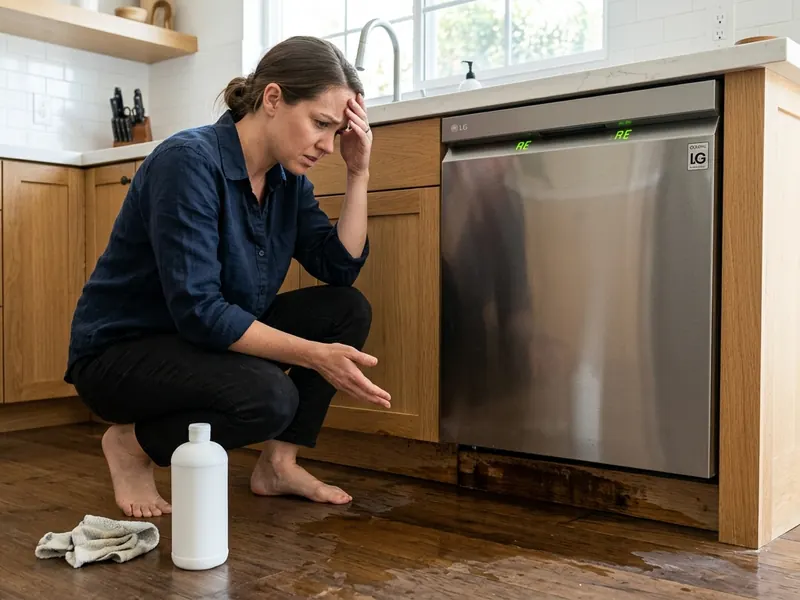
Water on the floor in front of the dishwasher, a damp toe kick or cabinet, or the cycle stops with an AE code because water has collected in the base pan.
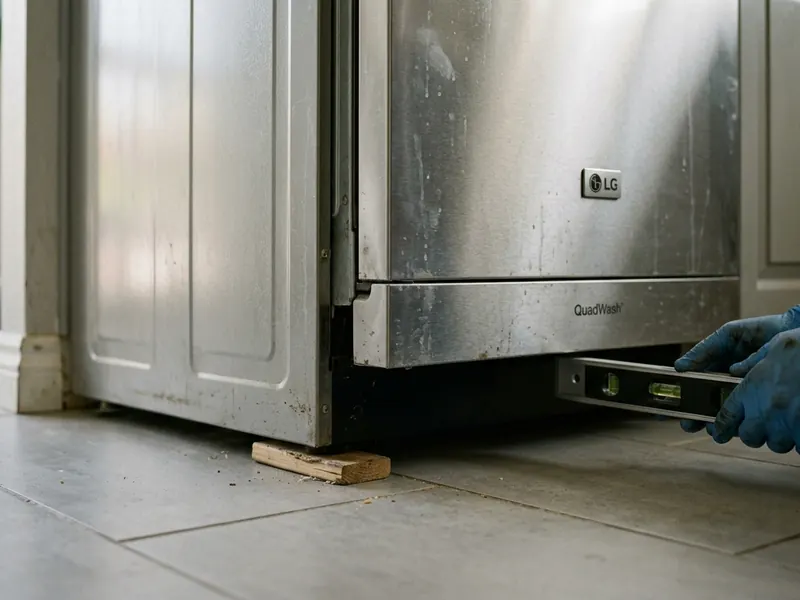
One of the most common reasons we find, especially on new installs. The front legs and the rear adjuster screw (center of the bottom frame on most models, left and right screws on some) set the tub angle. If the front sits low, water rides up against the door gasket every time the arms spray.
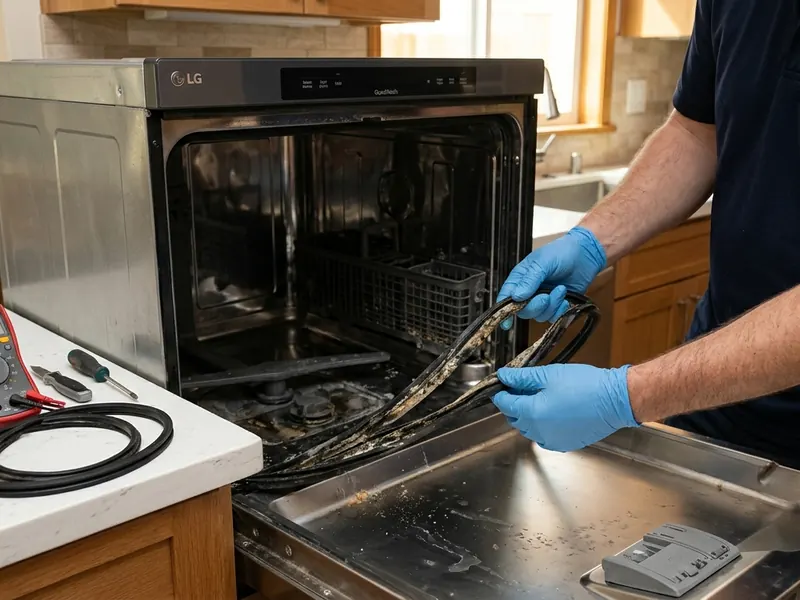
The gasket at the bottom of the door has to overlap the tub edge evenly. Installers sometimes knock it out of place, and grease buildup keeps it from sealing. We pull the outer door panel, inspect the gasket, clean the sealing surface and replace it if it's deformed.
A split in the lower arm shoots a jet of water straight at the door instead of up at the dishes. That pressure gets past even a good gasket. The crack is often only visible when you twist the arm.
A loose fitting on the supply line or a weeping inlet valve leaks behind the kick plate, so the water shows up at the front even though the source is underneath.
Some models have a gasket between the drying fan and the door that can be defective from the factory. The air guide on the left side of the tub can also leak if its nut works loose, though that one is rare.
A dent from shipping or installation on the bottom, the side or the front corner can distort the tub so it won't seal. Physical damage like that usually can't be repaired, and we'll tell you so honestly.
| Code | Meaning |
|---|---|
AE / E1 | Leak detected: water reached the base pan and tripped the float switch |
FE | Overfill: too much water came in, inlet valve or flow sensor fault |
Leaks that only happen mid-cycle are hard to find on a dry machine. We ask you to start a cycle before we arrive, then run it in test mode so we can watch each fill, wash and drain step with the kick plate off and a flashlight on the base. If it won't repeat, we follow the water trails back from where you saw the puddle.
A level goes on the tub opening, side to side and front to back. We adjust the front legs and the rear adjuster, then check that the unit isn't twisted in the cabinet opening and the anti-tip brackets aren't pulling the frame out of square.
With the outer door panel removed (six screws on most LG models) we can see the bottom gasket, the fan gasket and how they meet the tub. We look for a gasket that's rolled, torn, flattened or not overlapping the tub lip, and for grease on the sealing surface.
We drain the base pan, dry it, and run the machine again while watching the inlet valve, the supply fitting, the sump and pump seals and the air guide. Water that appears in the pan within a minute or two of a fill points at the inlet side. Water during the wash points at the pump or sump seals.
A full cycle with the kick plate off and dry paper under the unit. We don't leave until the base pan stays dry and the AE code is cleared.
Most LG dishwasher leaks we see are simple: a unit that isn't level, a gasket that got pushed out of place, or a cracked spray arm. Those are quick fixes. If the tub itself is dented we'll say so before you pay for parts, because no gasket will fix a bent tub.
The usual reasons are a unit that tilts forward, a door gasket that's shifted or greasy, a cracked lower spray arm spraying at the door, or too many suds from the wrong detergent. Leveling and the spray arm are the first things we check.
Water has collected in the base pan under the tub and lifted the float switch. The machine stops filling and runs the drain pump to protect your floor. The water came from somewhere inside, so the code will come back until the leak itself is fixed.
We'd advise against it. A small leak under a dishwasher soaks into the subfloor and cabinet base where you can't see it. Shut the water valve under the sink and use it again after the leak is found.
Factory authorized LG repair, parts on the van, 90-day warranty. Same-day across Orange County.